PODCAST - sell once, impact thousands
===
[00:00:00] Learning Transformed is brought to you by eLearning Partners, your guide to designing transformational learning experiences in the age of AI. For millennia, human intelligence was the highest form of intelligence on Earth, until now. Hi, I'm AI. I can process more information in seconds than any human in a lifetime.
This shift raises not only practical questions about the future of learning, but existential ones about the meaning of human life, growth, and evolution.
On this podcast, hosted by me, Johnny Havey, we navigate these questions with clarity, creativity, and confidence. As the most adaptable species on the planet, we can not only survive the rise of [00:01:00] artificial intelligence, but create better human-centered AI-powered learning experiences that elevate humanity to a new era of abundance, transformation, and meaning.
AI is rising, and so are we.
Now, let's dive in.
What if you can make one sale and impact thousands? Well, today on the show, I'm gonna share with you exactly how my clients are able to impact thousands of lives with just one sale. This may be the most important thing I learned back at the Daniels College of Business at the University of Denver in my MBA program, the concept of selling one-to-one versus one-to-many.
Most people, [00:02:00] when they get in business, or most business owners like yourself... When I got into business, this is what I was focused on, selling one-to-one. My business is one, your business is one. I was looking for a customer, one person, one user of my product, one user of my service, one person I'm delivering value to, or maybe not even just one person, maybe one small business, one solopreneur.
Maybe that is a little more than one person, and that's who I was serving. Maybe that's who you've been serving, one-to-one. This can also be looked at, and this is what I learned in business school, as creating a B2C business, the B being you, being your business, your business entity, and the C being a consumer.
Well, consumers are one person, one entity. On the other side of things, I didn't even know how viable this was when I created eLearning Partners more than a decade ago, selling one-to-many. [00:03:00] I knew that we were probably more of a B2B company, meaning we're a business. You have a business. I have a business.
And I knew we were serving businesses, but I was focused on serving small businesses. Well, most small businesses have just a couple stakeholders, a couple people that you can impact. But when you look at serving big businesses or medium-sized businesses, even if you're serving a business with 10, 20, 30 employees, you are serving many.
You don't have to serve enterprises. You don't have to serve S&P 500 companies like I do at eLearning Partners to serve many. But this is the key to impacting thousands of lives with less sales. So I invite you to join me over here in the one-to-many, or what I like to call the one-to-a-lot. of many businesses.
[00:04:00] B2B businesses. This is where my clients find themselves impacting thousands of lives with each new sale, each new customer, each new business they bring into their world. You could be one of these business owners and business owners as well. I'm gonna show you today how you become a B2B, and more importantly, a one-to-many business.
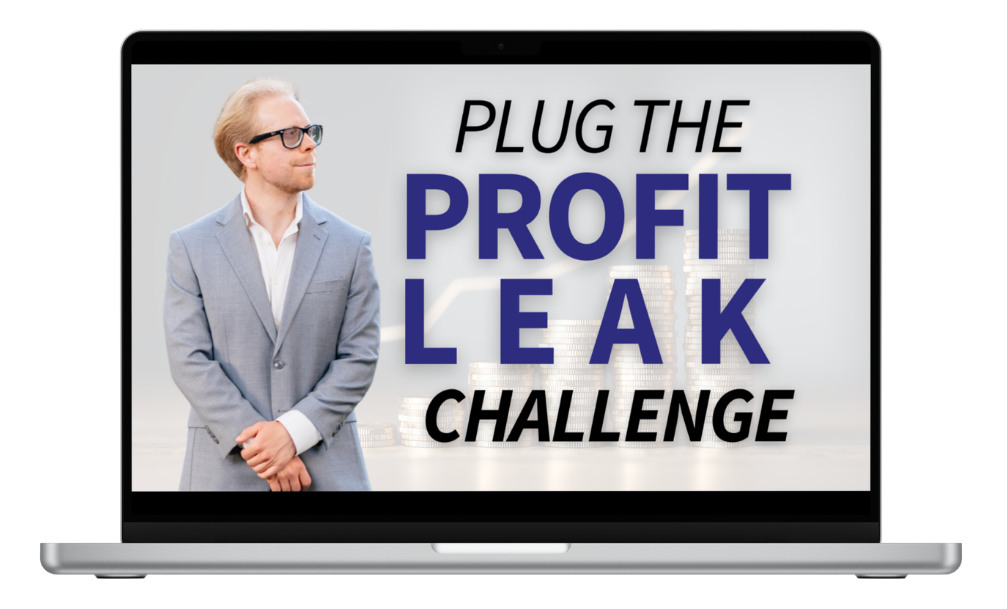
It all really comes down to a concept I teach in my Plug the Profit Leak Challenge, a multi-day group consulting experience where I work directly with you and other like-minded business owners, where we dive deep into your business to find where profit is leaking. We come up with a strategy of how to plug the leak, and we use what you already have in your business to create an even more powerful revenue engine that maximizes the increased profit margin that we create in your business.
I highly recommend you grab a ticket and grab a VIP ticket so you can spend twice [00:05:00] as much time with me and get my eyes inside of your business, get my consulting on your business directly by going to plugtheprofitleak.com, or just click on the link in the show notes and in the YouTube description if you're watching this on YouTube.
So why in the first place, other than making one sale and impacting thousands of people, would you want to be a one-to-many business? Well, it comes down to a concept that I teach called ROI Pie. What is ROI Pie? ROI is return on investment, the return that you and your business gets on your investment in anything.
So if you're investing in becoming a business that sells one to many, that is an investment you're making. And you wanna get a return out of it. The investment you're making right now into listening to this podcast episode, watching this video, you wanna get a return. When I first got into business, I remember selling my first deal, and I'm pretty sure it was $100.
And I was [00:06:00] pretty excited. Made $100. But then I had to figure out how to deliver the service that I was just paid $100 for. And yes, I did it, but I felt very underpaid. And I felt like the impact I was having was so small. Before I became an entrepreneur, I actually worked at PricewaterhouseCoopers as an IT auditor, became a CPA, earned my license, all the things.
And as a IT auditor and IT consultant at PricewaterhouseCoopers, one of the things that I really didn't like is I felt like what I was doing on a day-to-day basis wasn't moving the needle, wasn't impacting thousands, wasn't impacting the world. That's one of the biggest reasons why I left. Then, I sold my first deal for $100, and I still felt like I wasn't impacting the world.
When we look at ROI Pie- The first part of the pie, the first piece of the pie, the first pie of the pie is your ROI. So what you need to do is think about what is in it for you to selling one to many. Well, the first thing is now that I sell one to [00:07:00] many, I am selling 115K plus deals all the way up to offering a $500,000 service with my enterprise learning partnership program, where I partner with organizations like I've done with CoStar Group, becoming their e-learning partner for the past four years, helping them save millions of dollars in their business while increasing adoption, so product adoption, customer retention, so that customers stay longer, and increasing revenue from their education products.
I've done this with Cashmira, where we are working on changing the behavior of healthcare professionals to feel confident prescribing a better healthcare remedy to their patients is where I play now. I'm no longer in the, "I'm gonna charge $100 for something" range. And I do this because, yes, I wanna impact thousands just like you.
So we can add that in our ROI pie, [00:08:00] impact thousands, if not more. But I also have higher profit margins. So this is one of the returns I get on my investment in serving one to many, higher profit margins. I also have more revenue with way less sales. This is my ROI pie. Does this sound like something that you're interested in?
Well, if it does, then I have three steps of how you can harness the ROI that you're looking for to change your business and to change the world. And really, the first two steps are aligning your ROI pie with the ROI pie of your buyers and your customers. So here are the three steps to selling one to many.
Step one is to do what we just did with your business with your buyer. So identify the ROI of Your buyer. Now I look at buyers and customers differently. Buyers are the [00:09:00] ones who make the purchase decision to buy your product or service. Customers, in my mind, are the users, the end users, the people that consume your product or use your service, benefit from your product or service.
To be fair, your buyer can also benefit from it. The whole reason why we need to identify the ROI of your buyer is because your buyer is purchasing whatever you have to offer, your product, your service. They're purchasing your product or service because they're looking to get a return on their investment.
Their return may be very different from your customer's return, from the end user. While when you're selling one to many, you're really still selling to one buyer. Now there may be a couple people at the organization who make the purchase decision, I get it, but the buyer that you're selling to is purchasing what you are selling for X amount of people.
If you are like my S&P 500 company client, CoStar Group, they sell software as a service in the commercial real estate [00:10:00] industry, where they serve real estate professionals, commercial real estate professionals worldwide, commercial real estate students worldwide, and commercial real estate professors worldwide in a number of verticals ranging from hotel, restaurant, tourism management, all the way up to commercial real estate and residential real estate brokers.
But they make most of their money selling hundreds and thousands of licenses of their product to one buyer. Marriott will buy X amount of licenses. Cornell University will buy X amount of licenses. Well, what we've done is we've taken their education product that they sell to increase the adoption and the retention of their product with their customers.
We have made it so that Cornell calls us up and is like, "I want 200 licenses of this certification that certify my students in how to use your technology and how to use it in this specific industry." One Buyer, Cornell University. Many people affected. Value is being created for [00:11:00] many people. And Cornell buys every semester.
We're talking about hundreds of sales every semester from Cornell. We're talking about hundreds of sales, thousands of sales every year from Marriott. One buyer, many customers. So same thing that you did with creating your own ROI pie, what we need to do is here's your pie right here. We need to look at your buyer pie.
And your buyer may have a lot of different ROI pieces they're looking at, and a lot of the things may not overlap with what you are able to provide, what your product is able to provide. Well, since you shared with me that one of the ROI pieces for you is that you want to impact thousands of people, impact thousands, sell once, impact thousands.
Well, if your buyer has thousands of people that need your product or service, and you're able to create a package that you can help implement and integrate into that buyer's company, and it solves a solution the buyer is [00:12:00] looking for... So Cornell University, what is the solution they want? Well, universities tend to want to have more students and to have more really high-qualified students.
Universities are higher ranked because their students get higher-paying jobs. More of their students get higher-paying jobs. So the ROI for the buyer, Cornell, for wanting to buy CoStar's product is can your product help our students get more jobs and better jobs? If that is true, then I'm gonna spend thousands, tens of thousands, hundreds of thousands of dollars with you in order to get this result.
That's what the buyer wants. The buyer wants to continue to be looked at as one of the top schools in the world. You, your company, or my client in this case, their company, wants to be able to impact thousands with one sale and wants to be able to sell not only their technology product but their education product to the buyer to get major results in that organization.
Well, there's some overlap [00:13:00] here This is great. We can find a place of overlap between the ROI you want and the buyer wants. That's step one. Step two, we need to look at the customer. What are the students? What are the people the buyer is buying for? What are the people that Marriott's buying for? The customers, the people that Cornell's buying for, what do they want to get out of your product, out of your service?
What do your customers wanna get out of your product and service? What is their ROI so that the product that the buyer bought is actually used? 'Cause if the product isn't used, if the service isn't used, then the buyer can feel like they're gonna get their ROI out of it, but if the customer doesn't use it, then no one gets ROI.
You may have 'cause you made the sale, but you're not gonna make any more sales. The buyer might ask for a refund. So you have to align all three of these circles in order to have ROI pie, and this is your customer. So that brings us to step two, identify the ROI your customer/user wants. We have your ROI, [00:14:00] your buyer's ROI, and your customer's ROI.
And where we find the three pies overlap, this is the piece of pie that we need to put all of our focus and effort on, the piece of pie that all three, you and your business, your buyer, and your customers have in common. So let's go back to our example. Cornell buys a couple hundred licenses of the certification program and gets a couple hundred licenses of the software that Coaster sells.
What does the software and the certification program need to do for students in order for them to care about it? Well, it needs to help them get a job. So the great thing is the ROI of the buyer and the customer are aligned. They're a little different in how it affects them specifically 'cause Cornell is the buyer and the customer is the student.
But the student wants a job, and they want a job in something that they want to do. So if the buyer, Cornell, bought a program from someone or a software from someone, [00:15:00] maybe it'd be really good at helping people get jobs, but they're not jobs that people actually want or areas that people are interested in.
They can spend as much money as they want, but the customers, the students aren't gonna take those programs. They're not gonna get any value out of those programs. But when they- Look at, hey, people really love hotel, restaurant, tourism management. This software empowers these professionals to be data experts at hotels, restaurants, and tourism management.
And this certification is looked at very renowned in the industry to help you get a job. We're gonna invest in the certification. We're gonna get more jobs for our students. The university makes more money. It's looked at even more powerfully because more people are getting jobs. Everything's aligned.
Your company makes money, the buyer makes money, Cornell makes money, and your customers actually make money, too. This is what we call a win-win-win. And this is really the only way to play the one-to-many game. You gotta create these win-win-wins. Now, sometimes the [00:16:00] buyer might also be the customer, and that's okay.
It just simplifies our ROI pie. But I invite you when you're looking at anything in your business, always look at what is the ROI each party is looking for. Align that ROI and multiply your impact. So once you've aligned that ROI, the next thing to do is create an offer to serve 10, 100, 1,000 or more people.
So if you've been selling one-to-one or B2C in your business, and you may not have an offer, a product, or a service that serves 10, 100, 1,000 people, what you can do is take what you're already selling and look at it as if I was selling to a business. Here is where the three circles overlap. So here is my product, my service, my offer right here in the middle of the ROI pie.
This is what I need to now make sure serves 10, 100, and 1,000 people. That's it. Create an offer. And if you're thinking about pricing, think about it. If you're serving [00:17:00] 10, then times what your one-to-one offer is by at least 10. If you're serving 100, times it by 100. So something that was 100 bucks is now 1,000 bucks.
Something that's 1,000 bucks, now 10,0000 bucks. Something that's 10,000 bucks, now 100,000 bucks. And if you look at 10, 100, 1,000, something that was $100 serving 100 people is now 10,000. Crazy. Something that is $100 for 1,000 people, now 100,000. This just gives you an idea of where you could be playing.
And where I want you to be playing in your business is impacting more lives, serving more people, getting more ROI for you, your buyer, and the customer, creating a win-win-win Once you align the ROI of your business, your buyer, and your customer, your next step is to harness education as your competitive advantage.
This means it is up to you to make sure your buyer is [00:18:00] educated, knowing that your product and service is what they need to get a return on their investment. Your job is to educate your customer to know that investing their time into your product or service is what they need to get ROI. In my Plug the Profit Leak Challenge, my multi-day group consulting experience, we not only dig even deeper and help you figure out your ROI pie, we help you harness what you figure out into a competitive advantage that you can use to plug the profit leak in your business, increase your revenue, and impact thousands and thousands of lives.
Grab your ticket. Linked in the show notes and in the YouTube description, or go to plugtheprofitleak.com. I'll see you in the next episode
Thanks for tuning in to Learning Transformed. Now, if you're designing a transformational learning experience and wanna skip [00:19:00] the overwhelm of trial and error, check out our e-learning platform finder. Just answer a few simple questions, and we'll match you with the right platform, plus an extended free trial.
And as a bonus, you'll get free access to a course that walks you through building your learning experience on your matched platform. Click on the link in the show notes or go to www.e-learningpartners.com/elearning-platform-finder. I'd also love to hear from you. Leave a review on Apple Podcasts or Spotify or drop a comment on our YouTube channel.
Thanks for listening, and I'll catch you in the next episode.
AI is rising, and so are [00:20:00] we.